
Clearing agents handle customs documentation and KRA compliance to release cargo at Port, whether Mombasa or JKIA; freight forwarders arrange transportation and logistics coordination; and 3PL providers manage your entire supply chain, including warehousing, inventory, and last-mile delivery. Understanding these three distinct services is critical for Nairobi importers and exporters to optimize costs, reduce delays, and ensure regulatory compliance.
What’s the Core Difference Between Clearing, Forwarding, and 3PL?
These three logistics functions serve different purposes in the import-export journey:
- Clearing = Regulatory compliance. A licensed clearing agent submits import/export declarations to the Kenya Revenue Authority (KRA), calculates duties and taxes, and obtains cargo release at port entry points.
- Forwarding = Operational coordination. Freight forwarders arrange transportation modes (sea, air, road), negotiate carrier rates, consolidate shipments, and manage pre-arrival documentation.
- 3PL = Comprehensive management. Third-party logistics providers own warehouses, manage inventory, handle order fulfillment, and coordinate last-mile delivery—essentially outsourcing your entire supply chain.
Key distinction: Clearing is regulatory; forwarding is operational; 3PL is comprehensive management. Most Nairobi importers use clearing agents and forwarders separately, but integrated 3PL solutions consolidate all three functions.
Delta Cargo Connections Insight: As a licensed clearing agent, forwarder in Kenya, Delta Cargo Connections handles KRA compliance, duty calculations, and port coordination, operational coordination for import and export. We’ve processed over 5,00 vehicle clearances at Mombasa Port, reducing average port dwell time from 7 days to 3 days through streamlined documentation and pre-clearance coordination.
Quick Takeaway: Clearing = customs release; Forwarding = transportation logistics; 3PL = end-to-end supply chain outsourcing.
What Does a Clearing Agent Do in Kenya?
A clearing agent is your regulatory gateway at Mombasa Port and JKIA. They perform four critical functions:
- KRA Declaration Submission: Submits IDF forms to the Kenya Revenue Authority with complete cargo documentation, HS codes, and commercial invoices.
- Duty & Tax Calculation: Calculates CIF (Cost, Insurance, Freight) value, applies correct tariff rates, and determines VAT (16%), excise taxes, and port handling fees. For example, importing a Japanese used car valued at KES 2,000,000 incurs approximately KES 600,000–800,000 in duties and taxes.
- Port Coordination: Liaises with Mombasa Port Authority and JKIA cargo terminals for cargo inspection, X-ray screening, and physical examination if required.
- Cargo Release: Obtains final release authorization once all duties are paid and inspection is cleared, allowing cargo to exit the port.
For car importation specifically, clearing agents verify HS codes (8704.21 for used vehicles), obtain import permits from the Kenya Bureau of Standards (KEBS), confirm NTSA registration readiness, and process duty payments at KRA offices in Nairobi or Mombasa.
Quick Takeaway: Clearing agents are licensed professionals who navigate KRA requirements, calculate taxes, and secure cargo release—they’re essential for legal port entry in Kenya.
How Does Freight Forwarding Differ From Clearing?
Freight forwarders manage transportation logistics before and after port arrival; clearing agents handle customs compliance at the port itself.
- Transportation Arrangement: Forwarders negotiate sea freight rates with shipping lines (MSC, Maersk), arrange air cargo with airlines, and coordinate road transport from ports to final destinations in Nairobi or other cities.
- Documentation Management: They prepare bills of lading (B/L), commercial invoices, packing lists, and certificates of origin—but they don’t submit KRA declarations or pay customs duties.
- Consolidation & Route Optimization: Forwarders consolidate LCL (Less than Container Load) shipments to reduce costs, optimize shipping routes, and arrange deconsolidation at destination ports.
- Pre-Arrival Coordination: They notify port authorities of incoming cargo, arrange cargo insurance, and coordinate with clearing agents for smooth handover.
Delta Cargo Connections Logistic Company Insight: Our freight forwarding partnerships with major shipping lines enable us to secure preferential rates for Kenyan importers and exporters . By consolidating multiple vehicle shipments from Japan, Europe, USA, Uk, Germany, China, India we’ve reduced per-unit shipping costs by 25–35% compared to individual bookings, passing savings directly to clients.
Example: A flower exporter in Kenya uses Delta Cargo Connections freight forwarder in Kenya to arrange cold-chain sea freight from Mombasa to the United Kingdom, coordinate temperature-controlled container handling, and arrange onward air transport to European markets—all without touching customs clearance.
Quick Takeaway: Forwarders handle transportation and pre-arrival logistics; clearing agents handle customs compliance at port entry.
What Makes Third-Party Logistics (3PL) Different From Clearing & Forwarding?
3PL providers integrate clearing, forwarding, warehousing, inventory management, and last-mile delivery into a single managed service. Unlike clearing agents (regulatory only) or forwarders (transportation only), 3PL companies own or operate distribution infrastructure.
- End-to-End Supply Chain: 3PL manages your cargo from origin (Japan, Europe, UAE) through customs clearance, warehousing in Nairobi, inventory tracking, order fulfillment, and delivery to end customers.
- Infrastructure Ownership: They operate temperature-controlled warehouses, cross-docking facilities, and last-mile delivery fleets—reducing your capital expenditure.
- Real-Time Visibility: Advanced 3PL systems provide GPS tracking, inventory dashboards, and automated alerts for compliance and delivery status.
- Scalability: 3PL is ideal for growing businesses without dedicated logistics teams. You scale warehouse space and delivery capacity on-demand.
Example: A pharmaceutical importer uses the Delta Cargo 3PL Logistics solution to handle customs clearance of temperature-sensitive medicines, store them in climate-controlled warehouses (2–8°C), manage expiry tracking, and distribute to retail pharmacies across Kenya—all under one contract with compliance documentation automated.
Quick Takeaway: 3PL providers are comprehensive outsourced logistics partners managing customs, transport, storage, and delivery—ideal for businesses seeking operational simplicity.
When Should You Use a Clearing Agent vs. a Freight Forwarder?
Use a clearing agent when cargo arrives at the port, whether Mombasa Port or JKIA, and needs KRA release; use a forwarder for pre-arrival planning and transportation coordination. Most successful importers use both strategically:
| Activity | DIY Import (Risky) | Using Delta Cargo Connections |
|---|---|---|
| Source & Negotiate | You contact Japanese dealers, negotiate CIF prices | We connect you to vetted suppliers; negotiate favorable terms |
| Sea Freight Booking | You book shipping directly (often overpay) | Our freight partners secure 25–35% savings on container rates |
| Port Arrival Coordination | You notify port (delays common) | Pre-clearance documentation filed; cargo ready for inspection |
| KRA Customs Clearance | You hire random agent (compliance risk) | Licensed clearing agent handles all KRA submissions; duty optimization |
| NTSA Registration | You navigate NTSA separately (delays) | We coordinate NTSA registration; vehicle ready for road use |
| Typical Timeline | 45–60 days (port dwell delays) | 25–30 days (streamlined process) |
Optimal Strategy: Hire a freight forwarder (or Delta Cargo Connections) to arrange sea transport from any country; hire a clearing agent at Mombasa Port for customs release; coordinate both for seamless handover. This separation of duties ensures competitive pricing and regulatory compliance.
Quick Takeaway: Clearing agents for port compliance; forwarders for transportation—use both for cost efficiency and speed.
How Do 3PL Providers Complement Clearing & Forwarding Services?
3PL providers integrate clearing and forwarding into one platform, eliminating vendor coordination overhead and reducing total supply chain costs.
- Single Point of Contact: Instead of managing a clearing agent, forwarder, and warehouse operator separately, 3PL consolidates all relationships into one contract with unified billing and accountability.
- Cost Optimization: 3PL providers leverage shared warehouse space, consolidated shipments, and optimized transport networks—reducing per-unit logistics costs by 15–25%.
- Compliance Automation: Integrated 3PL systems automate KRA submissions, duty calculations, and regulatory documentation, reducing human error and audit risk.
- Inventory Intelligence: Real-time inventory tracking prevents overstocking, reduces carrying costs, and enables just-in-time ordering from suppliers.
Delta Cargo Connections Insight: Delta Cargo Connections offers integrated 3PL solutions combining our clearing expertise with freight forwarding and Nairobi-based warehousing. E-commerce importers benefit from customs clearance, secure storage, and same-day delivery coordination—all tracked in one dashboard. Our average client reduces logistics costs by 20% while improving delivery speed by 40%.
Example: An e-commerce retailer imports fashion from United Kingdom and electronics from China. Using Delta Cargo Connections’ 3PL service, all shipments consolidate at our Mombasa warehouse, clear customs together (duty savings), store in our Nairobi facility, and distribute to retail partners—eliminating separate vendor relationships and reducing total supply chain complexity.
Quick Takeaway: 3PL providers streamline clearing, forwarding, and warehousing into one integrated service, reducing costs and operational complexity.
Key Takeaways for Nairobi Importers
- Clearing agents are mandatory for KRA compliance and cargo release at Mombasa Port or JKIA—non-negotiable for legal imports.
- Freight forwarders optimize transportation costs and pre-arrival logistics—essential for competitive pricing and schedule reliability.
- 3PL providers integrate all three functions plus warehousing and delivery—ideal for growing businesses seeking operational simplicity.
- Cost-effective approach: For car imports, use a forwarder to arrange sea freight from Japan, a clearing agent for Mombasa Port release, and coordinate both for seamless handover. This reduces total import time from 60 days to 25–30 days.
Delta Cargo Connections specializes in all three services for car importation, pharmaceuticals, and general cargo. Our licensed clearing agents, freight forwarding partnerships, and Nairobi warehousing ensure your cargo moves from Japan to your driveway with zero regulatory risk and maximum cost efficiency.
Ready to import your first vehicle or scale your logistics operations?
Contact Delta Cargo Connections for a FREE car import consultation.
Phone: +254 722718358 Email: | info@deltacargoconnections.com
experienced Clearing and Forwarding Agents
We’re here to help
Get in touch with us today for expert clearing, forwarding, and comprehensive logistics solutions. We ensure smooth, hassle-free cargo movement with efficiency and professionalism. Let us handle your logistics needs.

continue reading
Related Posts
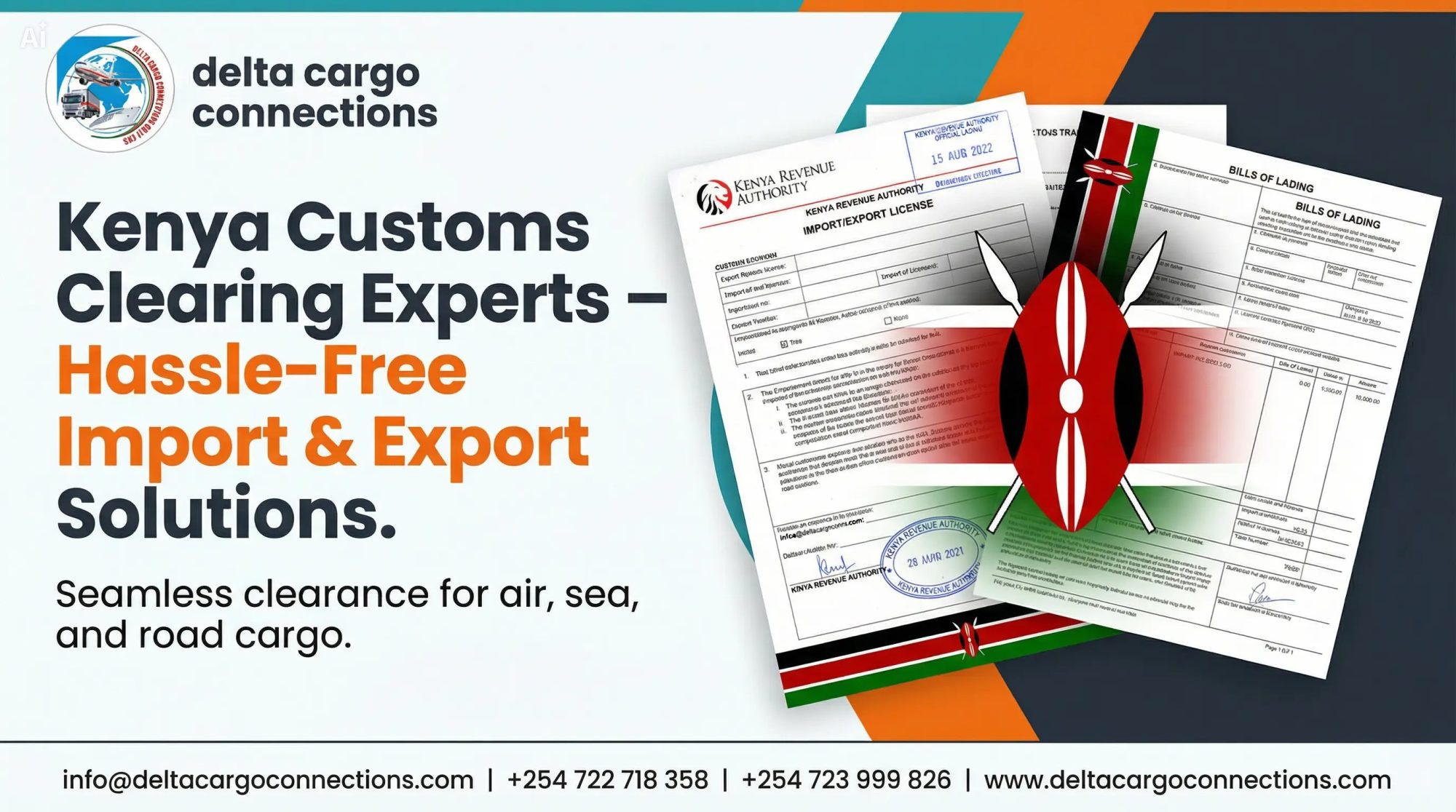
Custom clearance services in Nairobi are essential for legally importing or exporting goods through Kenya’s key entry points such as Jomo Kenyatta International Airport (JKIA) [...]
A custom declaration service in Nairobi is the official process of submitting cargo details to the Kenya Revenue Authority (KRA) for import or export clearance. [...]
Customs clearance services in Kenya are essential for legally importing or exporting goods through entry points such as Mombasa Port and Jomo Kenyatta International Airport [...]